
The Rise and Risks of Digital Menstrual Tracking
The GenderSci Lab has a new paper out in The BMJ, a collaboration between the GenderSci Lab and scholars in sports science and exercise medicine. The paper emerged from an international workshop hosted by the Lab at Harvard’s Radcliffe Institute for Advanced Study in 2025, where participants discussed emerging trends in the field of female athlete health.

The article responds to the recent and widespread promotion of commercial digital menstrual tracking tools by “femtech” companies and other digital health purveyors, on social media, in wellness messaging, and by elite women athletes suggesting that health, fitness, and wellness can be optimized by aligning activity and nutrition with crudely estimated menstrual phase.
“Neither digital menstrual tracking nor related practices of cycle syncing––that is, synchronising physical activity and nutrition to menstrual cycle phases––have been convincingly shown to improve health or other performance outcomes. Moreover, these practices raise serious concerns, given their risks of harm.”
In this statement on the risks of digital menstrual tracking by leading scholars, we make clear that these claims are not supported by evidence and carry risks to reproductive privacy and autonomy. Our analysis looks both at menstrual physiology and the technological limitations of digital cycle-tracking technologies, arguing that simplistic digital menstrual tracking methods and cycle-syncing trends are part of a dangerous resurgence of essentialist claims about the menstrual cycle and women and girls’ vulnerabilities and capabilities.
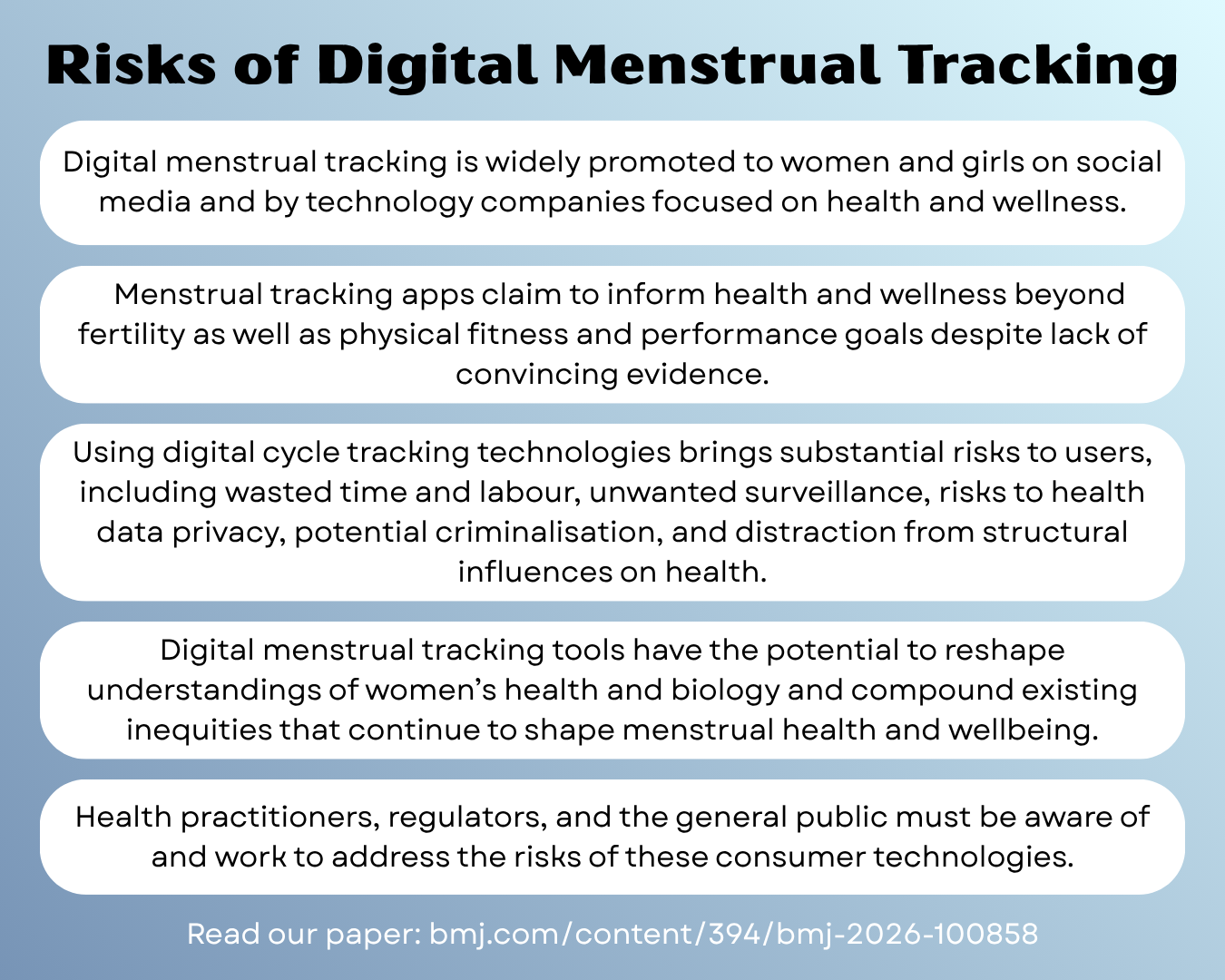
To the best of our knowledge, “Digital menstrual tracking risks creating more harm than benefit” is the first joint statement by a cross-section of experts in a major medical journal cautioning practitioners and the public against the use of these digital tools to manage menstrual conditions or to direct fitness and nutrition behaviors. Even if professionals in healthcare know these claims are false, clinicians and public health researchers should understand that many people believe them and are spending time, energy, and money trying to optimize their habits around their menstrual cycle using digital apps.
“Women’s health will be better supported by focusing on reducing inequities that continue to shape menstrual health.”
This work emerges from larger streams of work within the GenderSci Lab. This includes our scholarship on the interaction between gendered social variables and sex-related biological variables in sports science and medicine (Danielsen et al., 2025; Lee et al., 2023; Reiches et al., 2026) and on the transformation of the women’s health sphere by increased financialized investment in women’s health and health technology (Bruch & Richardson, 2023; Marsella et al., 2026; Borsa et al., 2020; Marsella et al., 2024)
We hope that “Digital menstrual tracking risks creating more harm than benefit” advances public understanding and dialogue about a prominent but troublesome emerging practice in women’s health and digital health technology.
Read the full article here: Katharine M. N. Lee, Marina DiMarco, Madeleine Pape, Meredith Reiches, Patricia Homan, Sheree Bekker, Margo Mountjoy, and Sarah S. Richardson. “Digital menstrual tracking risks creating more harm than benefit”. BMJ 394 (2026): e100858. https://doi.org/10.1136/bmj-2026-100858.
SUGGESTED CITATION
Lee, K. M. N. and Richardson, S.S. “The Rise and Risks of Digital Menstrual Tracking.” GenderSci Lab Blog. 30 September 2026. https://www.genderscilab.org/blog/the-rise-and-risks-of-digital-menstrual-tracking.
STATEMENT OF INTELLECTUAL LABOR
This blog post was drafted by Katie Lee and Sarah Richardson. The work for this article was partly supported by a grant from the Robert Wood Johnson Foundation (79892 to SR). We thank the participants in the Radcliffe exploratory seminar “Sexed Bodies in Sport” and the Radcliffe Institute for Advanced Study at Harvard University for supporting the workshop. Thanks to Ann Caroline Danielsen and Annika Gompers for assistance during the seminar and comments on an earlier draft.