
Sex Contextualist Frameworks
Proposed by Sarah S. Richardson in her 2022 paper, sex contextualism is a framework for operationalizing and analyzing sex in a way that attends to its pluralist, context-specific forms across biomedical research. We offer a beginner-friendly teaching slide deck and research handout to equip researchers, educators, and students with critical tools for understanding sex contextualism as a meaningful conceptual and practical framework.
Sex Contextualism
SUGGESTED PAPER CITATION
Richardson, S. S. (2022). Sex contextualism. Philosophy, Theory, and Practice in Biology, 14, Article 2. https://doi.org/10.3998/ptpbio.2096ttps://doi.org/10.3998/ptpbio.209
Teaching Slide Deck
The following slidedeck:
addresses the motivation for, and pitfalls of, attending to sex-related variation;
explains sex contextualism in contrast to sex essentialism;
touches on the practical implications for laboratory scientists.
It suits intro biology, feminist science studies, and philosophy of biology classes, and other teaching settings.
SUGGESTED GENERAL SLIDE DECK CITATION
GenderSci Lab. (2022, April). Sex contextualism: Teaching slidedeck by Harvard University’s GenderSci Lab. https://www.genderscilab.org/gendersci-lab-methods-toolkit
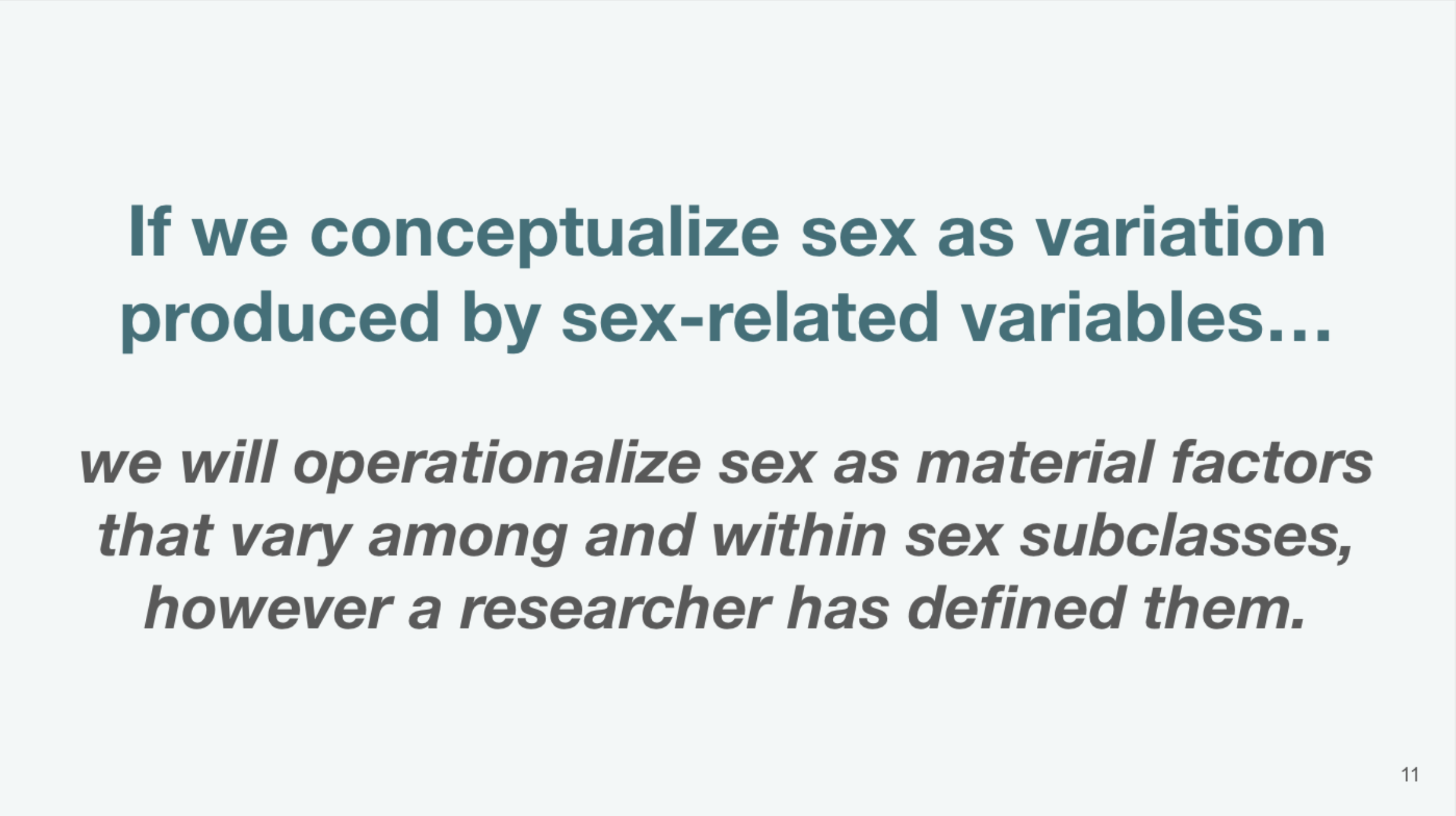
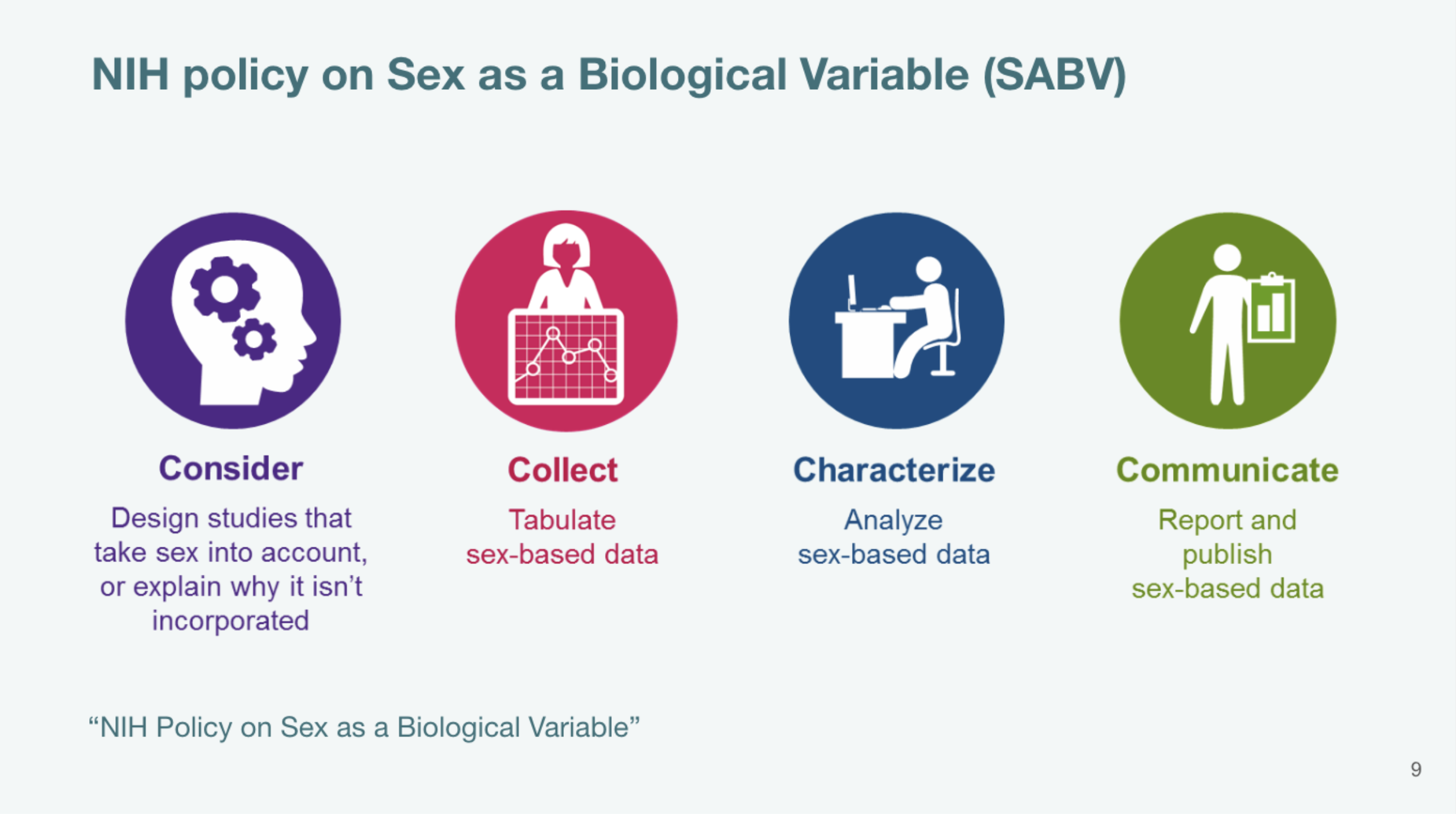
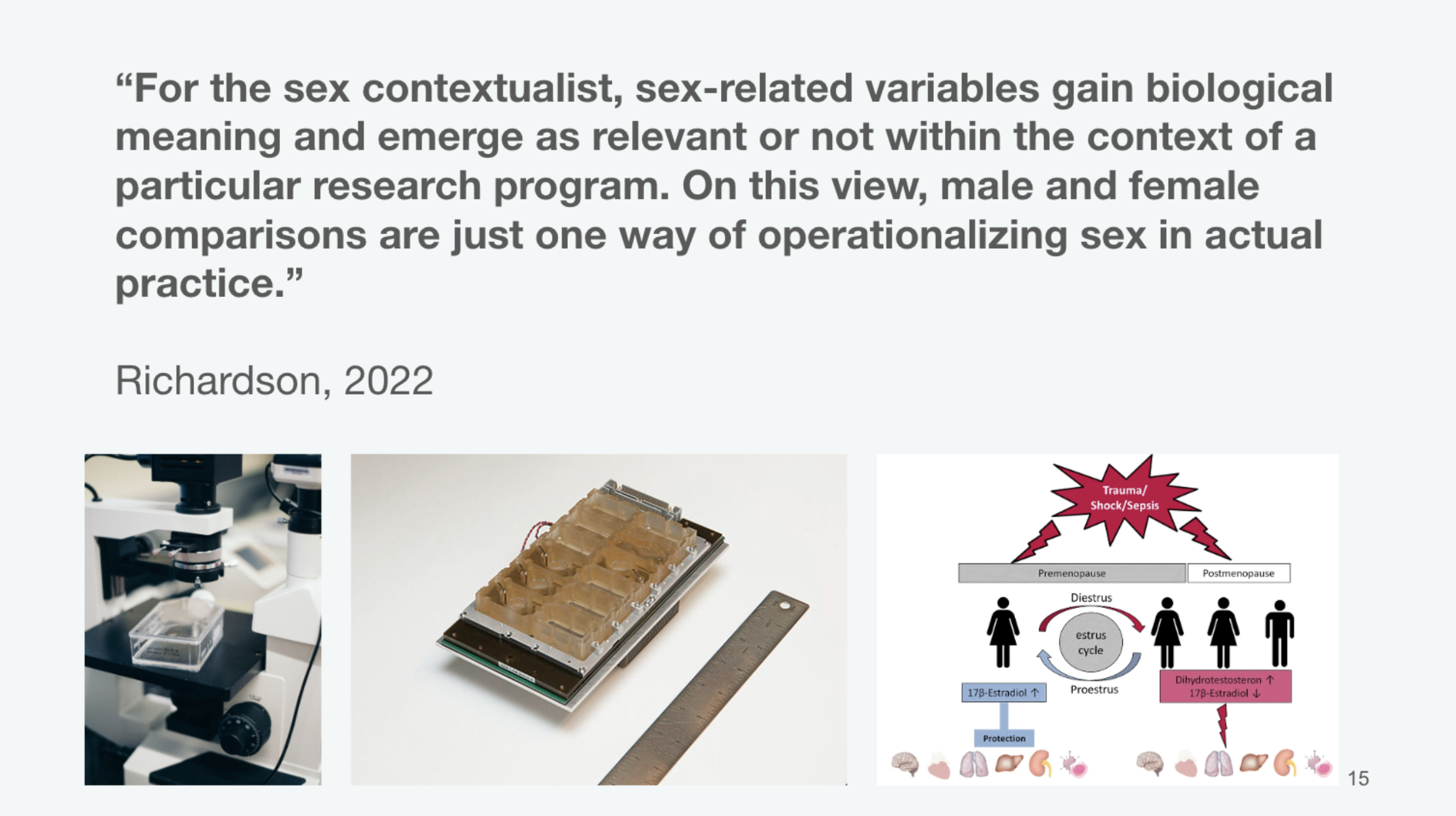
Using the slides: please don’t alter them after download. If you use only a portion, keep the GenderSci Lab logo and cite appropriately.
STATEMENT OF INTELLECTUAL LABOR
Sarah Richardson wrote this teaching module using materials from her own presentations and a presentation that Marina DiMarco, Mia Miyagi, and Kelsey Ichikawa created. Kelsey Ichikawa formatted and captioned the module and wrote this blog introduction that this teaching module took inspiration from.
FOR CITING SELECTED SLIDES ONLY
GenderSci Lab. (2022, April). Sex contextualism: Teaching slidedeck by Harvard University’s GenderSci Lab (Slides x, y, z). https://www.genderscilab.org/gendersci-lab-methods-toolkit
Research Handout for Scientists
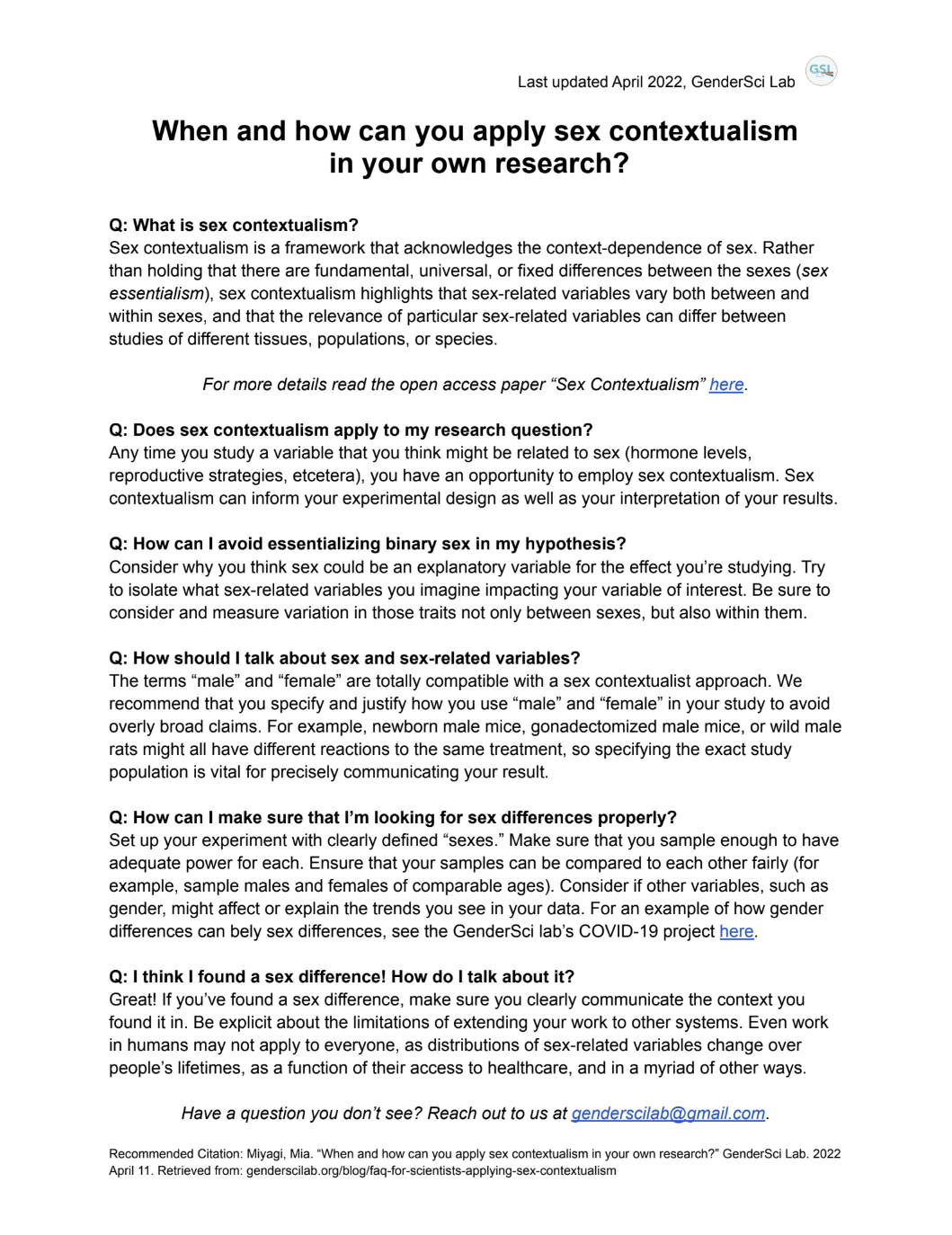
The following research handout is a condensed, portable, 1-page document that answers common questions about sex contextualist approaches in experimental design, execution, and reporting. We invite you to read it over and share it with other researchers.
SUGGESTED HANDOUT CITATION
Miyagi, M. (2022, April 11). When and how can you apply sex contextualism in your own research? GenderSci Lab. https://www.genderscilab.org/gendersci-lab-methods-toolkit
STATEMENT OF INTELLECTUAL LABOR
Mia Miyagi conceived of, wrote, and revised the document. Sarah Richardson, Marion Boulicault, Kelsey Ichikawa, and Heather Shattuck-Heidorn contributed edits and revision feedback.
Sex Essentialist vs. Sex Contextualist Frameworks
Two ways to conceptualize sex as a biological variable, as contrasted in Table 1 of Richardson’s sex contextualism paper.
CENTRAL CONCERN
Studies using material from one sex may not generalize to the other.
__________________________________________________________________________________________________________________________________________________________________
OMNIPRESENCE
Every biological system and material has a sexual identity, male or female.
__________________________________________________________________________________________________________________________________________________________________
POLICY GUIDANCE
Include male and female subjects or material and report differences between the two groups.
Sex Essentialism
CENTRAL CONCERN
Sex-related variables produce variation between and within sex-defined classes, depending on context. Male–female findings may not generalize to all males and females, or across species.
__________________________________________________________________________________________________________________________________________________________________
OMNIPRESENCE
The presence of sex-related biological variables in a material does not entail a causal relation to sex-specific biology, nor does it necessarily warrant a definitive label of “male” or “female” sex to that material.
__________________________________________________________________________________________________________________________________________________________________
POLICY GUIDANCE
Consider sex-related variation within a well-specified research context; male–female comparison may be neither necessary nor sufficient in capturing sex-related biological variation.
Sex Contextualism
How to Apply Sex Contextualism:
Before you operationalize sex, be explicit about what you mean.
Which sex-related material factors (hormonal milieu, gonadal anatomy, developmental pathway) am I actually studying?
Are my subclasses discrete or continuous, and how many are there?
Step 1
Define it
Explain why this operationalization fits your context.
Does it fit my species or strain, developmental stage, and level of analysis (cell, tissue, organism)?
Is male–female comparison apt here, or is another grouping (e.g., estrogen level) a better fit?
Step 2
Justify it
Ask what your sex-related finding can and can’t support.
Would it generalize across model systems, species, or to humans?
Could lab conditions (caging, diet, observer sex, cycle stage) be mediating it?
Step 3
Test its limits
Sex Contextualism Frequently Asked Questions
-
No. Sex is an evolved developmental pathway with many implications for biology, and that male–female comparison may sometimes be an apt design.
-
Though Richardson’s paper focuses on “sex” in laboratory-based biomedical research, sex and gender interact in practice. For gender/sex in human data, see the Three Maxims section.
-
Please use the slides as downloaded, and retain the logo and cite if using only some slides.
-
Yes! You can access a Q&A with Lab Director Sarah Richardson on our blog at this link.