
The false promise of digital menstrual cycle tracking in sport
Women’s sports are historically underfunded, understudied and deprioritized. Digital technology companies – like Fitr Woman – claim to offer a solution. By using digital apps to track their menstrual cycle, they suggest, women athletes and their coaches can leverage data to optimize their performances and minimize injury risk, thereby helping redress the effects of decades of sexist inequities. Cycle tracking has even been embraced by some elite sporting groups, such as the U.S. Women’s National Soccer Team.

The promise of digital tracking is based on the idea that the bodies of people who menstruate have phase-specific needs (e.g. for nutrition and rest), phase-specific vulnerabilities (e.g. to injury and over-training), and phase-specific capabilities (e.g. for strength or endurance). Therefore, if an athlete can reliably track where she is in the menstrual cycle, she can optimize her diet, training, recovery, and other behaviors accordingly.
The GenderSci Lab examines the promise of digital tracking in a new paper out in Social Science & Medicine. Implicit in claims that digital menstrual cycle tracking is a science-forward priority for female athlete empowerment, health and performance, there are five core assumptions. We articulate and critique these as follows:
Regular presence of menstrual bleeding is an indicator of overall athlete health.
Digital tracking of the menstrual cycle produces accurate menstrual cycle phase data.
Digital menstrual phase data will support the identification of potential effects of the menstrual cycle on performance, perceived exertion, and injury risk.
Digital tracking of menstrual cycle phase can support real-time, individualized, scientifically sound recommendations for athletes.
Digital tracking of the menstrual cycle is empowering for athletes.
Our interdisciplinary team of experts in reproductive health, sports medicine, women’s health, sports sociology, gender studies, bioethics, and science and technology studies considers each of these assumptions, and shows that evidence does not support the claim that digital cycle tracking empowers athletes and helps them reach their potential.
“To empower athletes and potentially justify its risks, digital menstrual cycle tracking must provide users with accurate information which they find valuable and which they have the means to use—or not use—to their benefit. Existing MC tracking applications do not consistently meet this brief.”
Assumption 1: As some sports scientists, clinicians, and athlete support professionals recognize, regular menstrual cycles do not always indicate good health–they can conceal underlying health concerns. Furthermore, irregular cycles may result from benign causes like hormonal contraceptive use.
Assumption 2 - 4: Digital algorithms often fail to predict cycle phase accurately. Even when cycle phase is correctly identified, effects of the menstrual cycle on athlete performance, health, and injury risk are negligible or nonexistent. Using digitally assigned cycle phases to modify behavior, therefore, is a recipe for baseless and possibly harmful intervention that could deprive athletes of opportunities to train and compete.
Assumption 5: In tandem with our recent analysis in The BMJ, we argue that focusing on the cryptic effects of cycle phase deflects attention from the systemic inequalities plaguing women’s sport, including low pay; insufficient facilities, training time, and coaching support; endemic harassment; and–yes–a lack of access to clean, safe spaces to manage menstruation, when those are needed.
“the speculative marginal benefit does not justify the potential harms of discounted athlete experience, invaded privacy, exploited data, and the diversion of resources from structural change”
The idea that digital menstrual cycle tracking can give athletes a leg up is present from the social mediasphere to the upper echelons of competitive sport–per the case study in our paper, the US Women’s National Soccer Team. Digital menstrual cycle tracking isn’t the path to women’s empowerment in sport. In fact, it takes our eyes off the ball.
Read the full article here: Meredith W. Reiches, Marina DiMarco, Katharine M.N. Lee, Madeleine S. Pape, Sheree Bekker, Marion Boulicault, Ann Caroline Danielsen, and Sarah S. Richardson. “Does menstrual cycle tracking enhance female athlete health and performance? Evaluating five implicit assumptions of an emerging paradigm”. Social Science & Medicine 408 (2026): 119790. https://doi.org/10.1016/j.socscimed.2026.119790

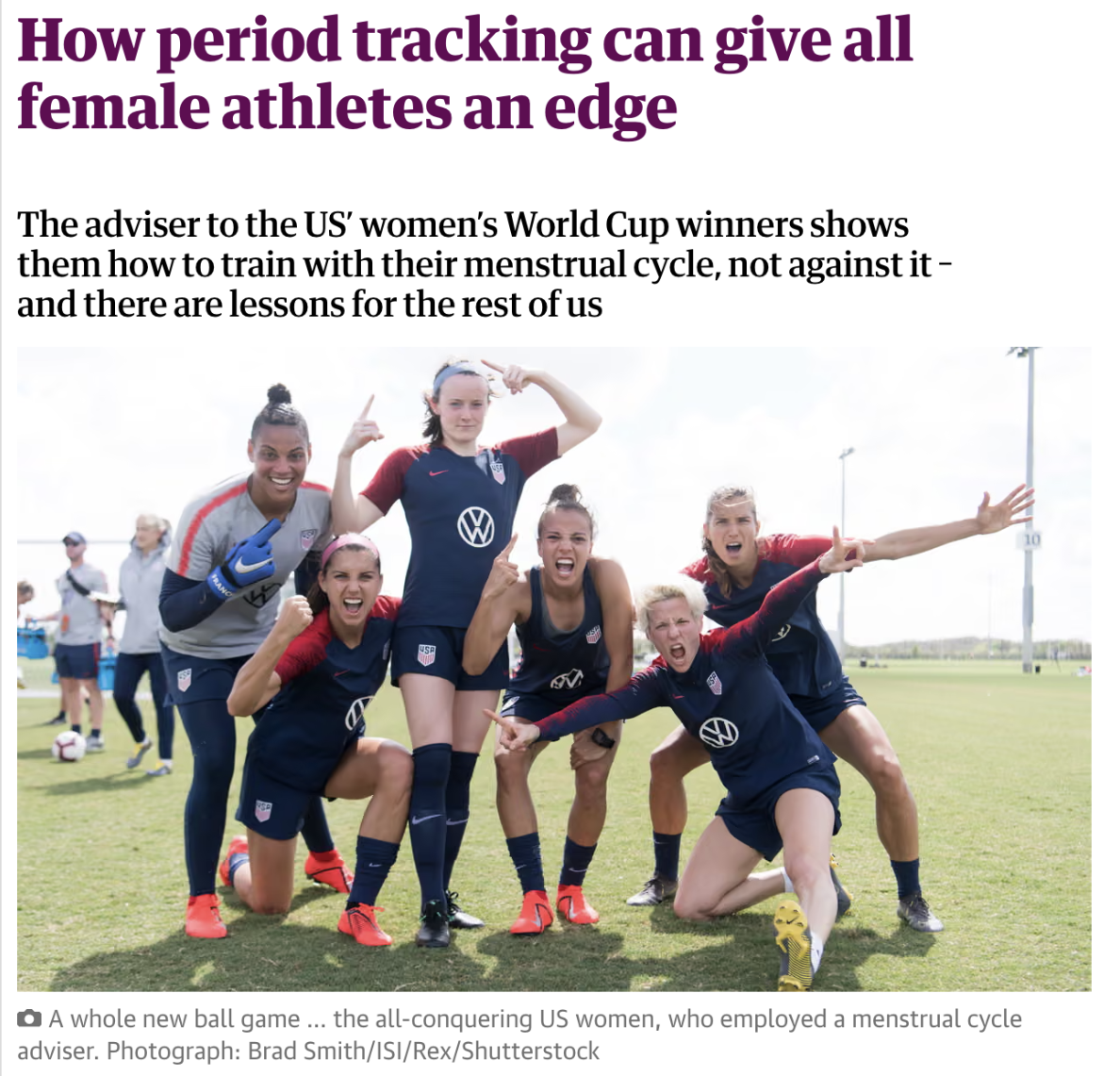
Screenshot of the US Women's National Soccer Team from The Guardian's feature, How period tracking can give all female athletes an edge.
STATEMENT OF INTELLECTUAL LABOR
Meredith Reiches drafted the blog post and Marion Boulicault and Sarah Richardson provided revisions. Katharine Lee also provided input on the final version.
RECOMMENDED CITATION
Reiches, M., Boulicault, M., & Richardson, S.S. “The false promise of digital menstrual cycle tracking in sport.” GenderSci Lab Blog. 20 October 2026. https://www.genderscilab.org/blog/the-false-promise-of-digital-menstrual-cycle-tracking-in-sport.